



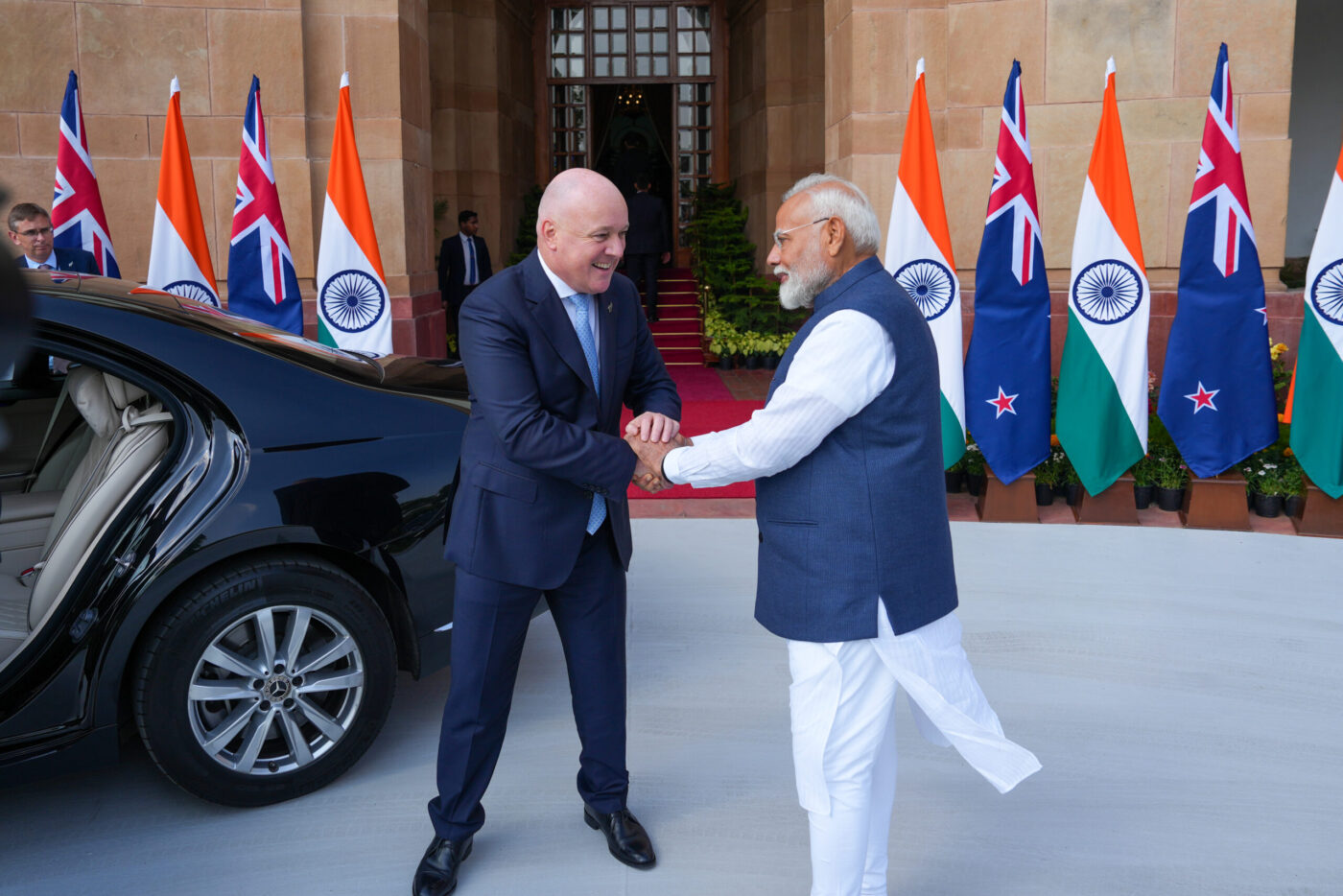
Prime Minister and Botany MP Christopher Luxon says the conclusion of a free-trade agreement between New Zealand and India is a “landmark moment” for this country.
The deal was announced today, December 22.
“I am delighted that, just nine months after [Indian] Prime Minister [Narendra] Modi and I launched negotiations on this deal during my visit to India, Trade Minister Todd McClay and his counterpart Piyush Goyal have delivered,” Luxon says.
“We made a campaign commitment to New Zealanders to secure a free-trade agreement with India in our first term, and our countries have pursued this with determination.
“This is about our plan to fix the basics and build the future.
“This is an incredibly exciting opportunity for New Zealand exporters, with tariffs immediately removed on more than half of New Zealand’s current exports to India from day one. The gains are wide-ranging and significant.
“India is the world’s most populous country and is the fastest-growing big economy, and that creates opportunities for jobs for Kiwis, exports and growth.
“Since the election, Todd McClay has visited India seven times. The Foreign Minister [Winston Peters] has visited India twice.
“Earlier this year, I led New Zealand’s largest-ever trade mission to India, and New Zealand has hosted India’s President and two Ministerial visits from India.
“The result is a high-quality trade agreement with a trusted partner that will deliver deep and lasting benefits for New Zealand.
“I have just spoken to Prime Minister Modi, who shares our excitement to further cement the strong relationship between New Zealand and India.”
Shortly after the agreement was publicly announced, Foreign Minister Winston Peters issued a statement saying the free-trade agreement between New Zealand and India was a “bad deal”.
His New Zealand First political party is “regrettably opposed” to the agreement, Peters says.
“We consider the India-New Zealand free-trade agreement to be neither free nor fair.
“Regrettably, this is a bad deal for New Zealand. It gives too much away, especially on immigration, and does not get enough in return for New Zealanders, including on dairy.
“New Zealand First urged its coalition partner not to rush into concluding a low-quality deal with India, and to use all three years of this Parliamentary cycle in order to get the best possible deal.
“We also indicated we felt it would be unwise for National to sign up to a deal with India when a Parliamentary majority for that deal was uncertain.
“Unfortunately, these pleas went unheeded. National preferred doing a quick, low-quality deal over doing the hard work necessary to get a fair deal that delivers for both New Zealanders and Indians.”
Peters says New Zealand First will vote against the agreement’s enabling legislation if and when it’s introduced to Parliament.
“While New Zealand is completely opening its market to Indian products under this deal, India is not reducing the significant tariff barriers currently facing our major dairy products,” he says.
“This is not a good deal for New Zealand farmers and is impossible to defend to our rural communities.”
Peters says the agreement would be New Zealand’s first trade deal to exclude this country’s major dairy products, including milk, cheese and butter.
In the year to November, New Zealand exports of these products were worth around $24 billion, or 30 per cent of our total goods exports.
“National has also made serious concessions to India in areas that have nothing to do with two-way trade, but rather relate to encouraging the movement of people from India to New Zealand and New Zealand investment in India,” Peters says.
“On a per capita basis, National has offered far greater access for India to our labour market than did Australia or the United Kingdom to secure their FTAs.
“This is deeply unwise given New Zealand’s current labour market conditions, with too many New Zealanders in unemployment or doing it tough economically.
“New Zealand First looks at all proposed changes on migration from the same standpoint: do they protect the ability of New Zealanders to find meaningful employment as well as the integrity of our immigration system?
“The India deal fails that test. By creating a new employment visa specifically for Indian citizens, it is likely to generate far greater interest in Indian migration to New Zealand, at a time when we have a very tight labour market.
“We also hold concerns that the deal ties the hands of future New Zealand Governments.
“The proposals around the work rights for Indian students, both when they study and after they graduate, would constrain the ability of future governments to make policy changes in response to changing labour market conditions.”

